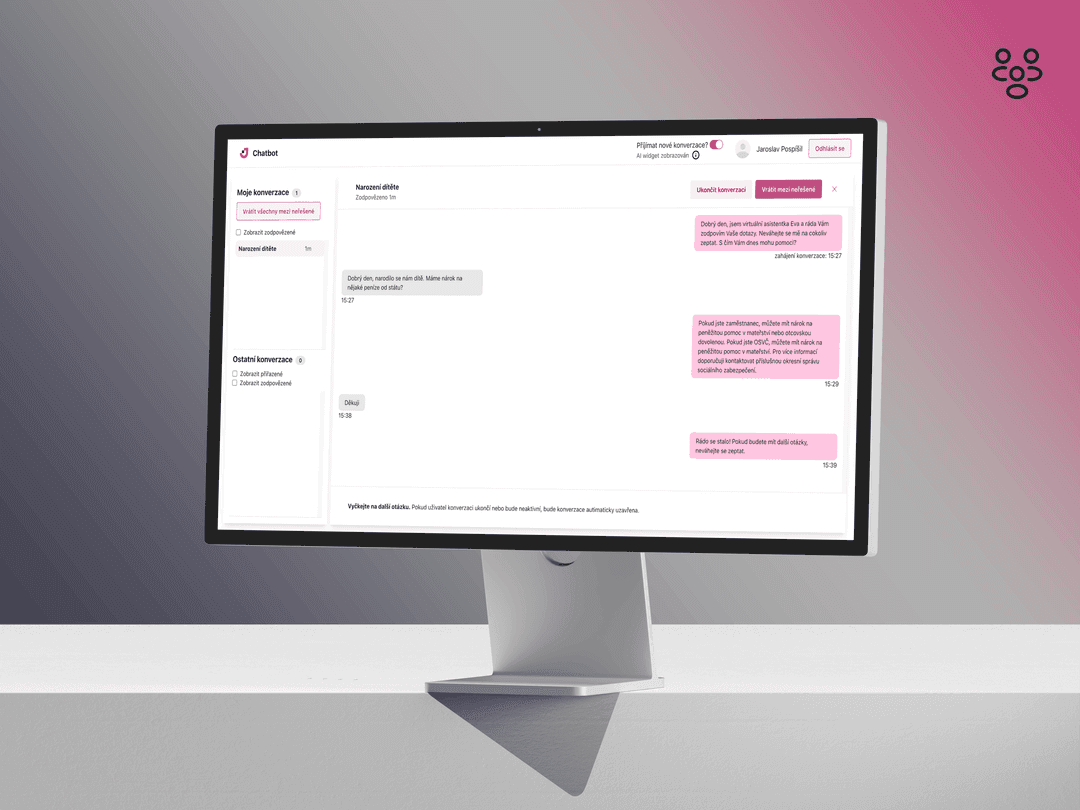
Digital assistant of the Ministry of Labour and Social Affairs – chatbot and voicebot for public communication

Client NameMinistry of Labour and Social Affairs

Client CountryCzech Republic

  • Client typePublic sector
  • IndustryGovernment & Public Services
  • Application areasCustomer Support & Experience, Operations & Process Automation
  • AI technologiesConversational AI (chatbots, voicebots), Generative AI, Large Language Models (LLMs), Natural Language Processing (NLP), Speech Recognition & Synthesis
  • Business impactsCustomer Product & Service Innovation, Employee Enablement & Productivity
  • Data typesAudio Data, Documents / Semi-structured Data, Other, Textual Data
  • Delivery modelsCustom Development
  • DeploymentsCloud
  • Key capabilitiesConversational & Language Interaction, Decision Support & Augmented Analytics
  • Project stagesProof of Concept (prototype / PoC / pilot)
  • Solution formsAnalysis, Recommendation, or Report, API / Micro-service Interface, Automated Backend Process, Conversational Interface, Multimodal Interface, Standalone Application, Web Portal / Dashboard

Solution Description

Problem description

Citizens often struggle to navigate the complex agendas of the Ministry of Labour and Social Affairs, while call centers are overloaded with a high volume of inquiries. Manual handling of questions is time-consuming, increases administrative burden, and reduces efficiency. The project addresses this challenge through an AI assistant that automates responses to frequently asked questions and enables quick escalation of more complex cases to human operators.

Solution

The project introduces a digital assistant for the Ministry of Labour and Social Affairs in the form of a chatbot and voicebot to provide citizens with verified public information. The assistant leverages retrieval-augmented generation (RAG), semantic search, and speech recognition for fast, consistent, and accessible communication. The goal is to provide citizens with reliable 24/7 answers, reduce the workload of call centers, and improve the efficiency of government–citizen communication.

Main Users of the Solution

General public, customer service operators

Project timeframe (months)

15

Technologies used

Python, LLM, Vector DB, Azure

Additional services

  • AI strategy and roadmap
  • Audit / feasibility study
  • Identification and prioritization of suitable use-cases
  • Data collection and pre-processing
  • Annotation / synthetic data / dataset augmentation
  • Data governance and data quality
  • AI model selection and customisation
  • Change management and user training
  • Systematic AI training programmes
  • Provision of MLOps infrastructure
  • Ongoing maintenance and model retraining

Implementation

Project Owner on the Client's Side

Business Architect

Participation on the Client's Side

  • Business / Product Owner
  • Domain / Process Experts
  • Project and Change Management
  • End users

Form of Supplier Involvement

Complete realization

Operation and Maintenance

Operational Model

Operations and maintenance are fully managed by Tekies.

Needed Competencies on the Client's Side

Call center staff, knowledge base guarantor, product owner.

Other Resources or Infrastructure

Azure, PTU for operating the voicebot, voicebot line operators (we only provide the LLM component)

Impact and Results

Qualitative Benefits

Availability according to the office hours set by the Labour Office. Faster citizen access to verified information.

Quantitative Results

Reduction of call center administrative workload by up to 40%.

Client Feedback

Faster citizen access to verified information.

Lessons Learned and Recommendations

Key Success Factors

The system is already in production, achieving high accuracy with an error rate below 5%. The digital assistant has processed tens of thousands of citizen inquiries. The deployment has significantly reduced the burden on call centers and has been positively received by both the public and the MoLSA staff.

Biggest Challenges

Implementation of the voicebot and technical integration of all components to achieve optimal fluency. Consolidation of unstructured documents and creation of a knowledge base. Implementation of the RAG system.

Recommendation for Others

In our practice of deploying AI systems to support organizations, we often encounter situations where clients attempt to address or optimize their challenges and processes using commonly available tools. However, these tools are usually designed as universal solutions, which in practice often leads to issues with accuracy, reliability, and overall efficiency. Our goal is to prevent such shortcomings already at the solution design stage. Thanks to our experience and proven methodologies, we are able to guide the client smoothly and effectively through the entire implementation process—from needs analysis to the deployment of tailored tools.

Stay informed with CNAIP. Subscribe to our regular mediamonitor and never miss an update in the world of AI. We’ll deliver a digest of the most essential news straight to your inbox.

By subscribing, you agree to our Terms of Service.

© cnaip 2026

Want to become a part of Czech AI?

Share your story and showcase what you can achieve with artificial intelligence. Your involvement will inspire others and help us map out the Czech AI scene in its entirety.